
Vertigo & Dizziness
Cervicogenic Dizziness vs. BPPV: How to Tell the Difference
By Dr. Max Orris, D.C. ·
BPPV (benign paroxysmal positional vertigo) and cervicogenic dizziness are two different conditions that often get confused because both can be triggered by moving the head. BPPV causes brief, true spinning vertigo — usually under a minute — from displaced crystals in the inner ear, and is confirmed with a specific positional test. Cervicogenic dizziness instead produces a non-spinning sense of unsteadiness tied to neck position or movement, has no single confirmatory test, and is diagnosed only after other causes, including BPPV, have been ruled out. Telling the two apart usually starts with ruling BPPV in or out first, since it is the more common and more directly testable of the two.
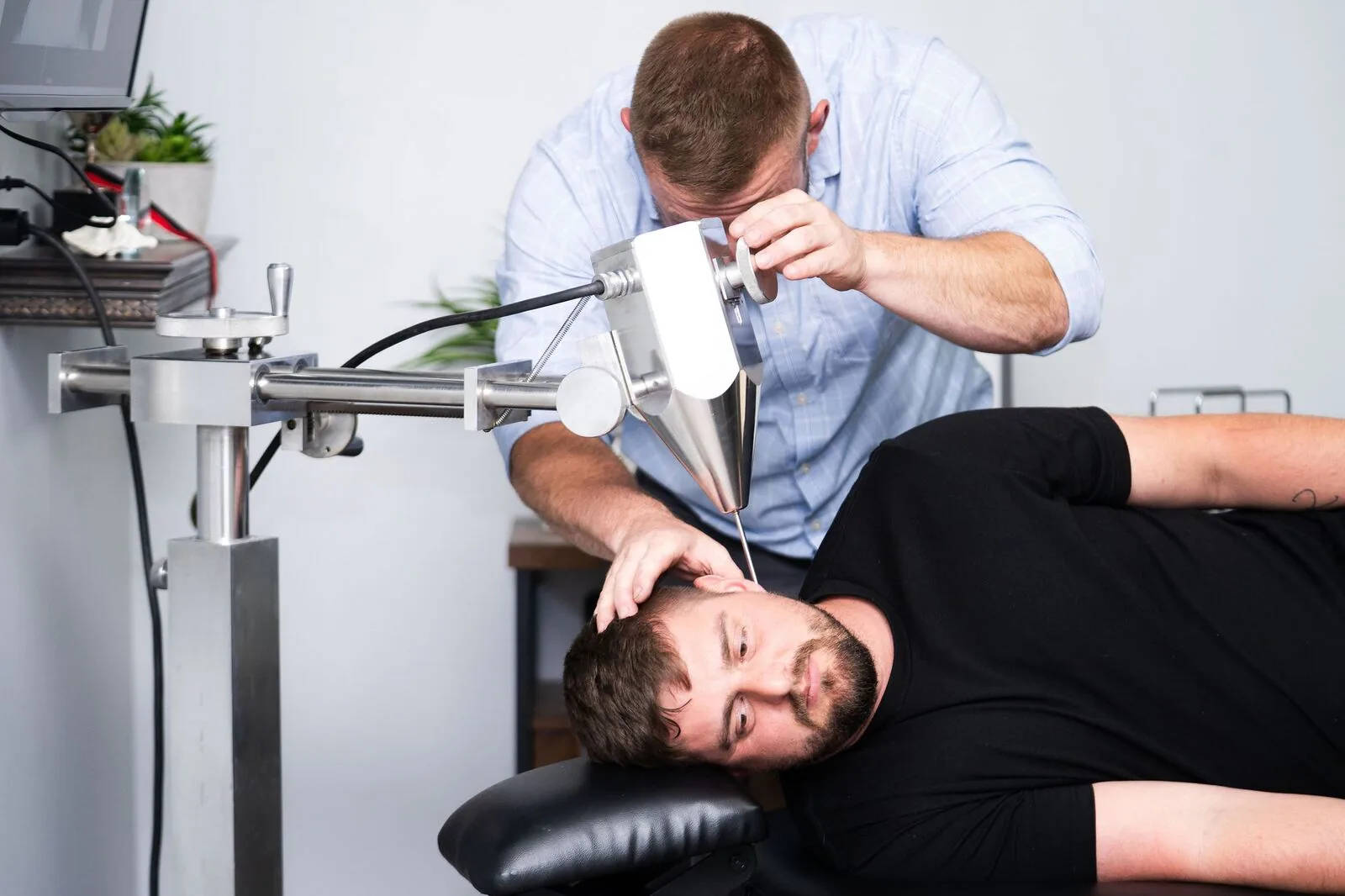
What is the difference between BPPV and cervicogenic dizziness?
BPPV happens when small calcium carbonate crystals called otoconia become dislodged from their normal position in the inner ear and drift into one of the semicircular canals, according to the Vestibular Disorders Association (VeDA). When the head moves into certain positions, those displaced crystals send a false signal of motion to the brain, producing a true spinning sensation that typically lasts well under a minute per episode, often triggered by rolling over in bed, tipping the head back, or bending down.
Cervicogenic dizziness is different in both feel and cause. It is thought to arise from disrupted signals coming from the joints, muscles, or nerve receptors of the neck rather than from the inner ear, and it tends to produce a non-spinning sense of unsteadiness, disorientation, or being pulled to one side — often alongside neck pain or stiffness — that is triggered or worsened by neck movement or sustained neck positions rather than by a specific head position.
How common is each one?
BPPV is well studied and common: VeDA cites an estimated incidence of about 107 new cases per 100,000 people per year, with a lifetime prevalence of roughly 2.4%, and notes it becomes more frequent with age, though it can occur at any age.
Cervicogenic dizziness does not have a comparable prevalence figure, because it has no diagnostic test to count cases against — it can only be diagnosed after other causes are excluded, so there is no reliable way to know how many people actually have it. That gap in the evidence is itself worth knowing about before assuming a neck-related cause.
How do clinicians actually tell them apart?
BPPV is confirmed with a specific positional test — most often the Dix-Hallpike maneuver, or the supine roll test when Dix-Hallpike is negative — in which a clinician moves the head into set positions and watches for the characteristic eye movements (nystagmus) that confirm which inner-ear canal is affected, per Physiopedia's clinical summary.
Cervicogenic dizziness has no equivalent single test. Physiopedia's screening summary notes that "no one test alone can diagnose" it, and that clinicians instead rely on a cluster of findings — cervical joint position sense, eye-head coordination, smooth pursuit testing, and general balance testing — alongside a history of neck pain or injury that lines up with the onset of dizziness, after vestibular and other causes have been ruled out.
One caution worth taking seriously: Vestibular First's clinical education material is explicit that neck pain alongside dizziness does not by itself confirm a cervical cause, and that migraine — not cervicogenic dysfunction — is actually the most common explanation for that particular combination of symptoms. A 2017 review in Archives of Physiotherapy makes the same point from a different angle, describing cervicogenic dizziness as a diagnosis reached only by exclusion, with no definitive clinical or laboratory test to confirm it directly.
What does this look like in an evaluation?
In our evaluations, the first question is always whether BPPV or another vestibular or medical cause is present, since those are more directly testable and, in the case of BPPV, often resolve quickly with a canalith repositioning maneuver performed by a primary care provider, ENT, audiologist, or vestibular physical therapist. Only once those have been reasonably ruled out does examining the neck's joints and motion for a possible cervical contribution make sense.
In our experience, patients who reach us after a negative BPPV workup and normal vestibular testing, but whose dizziness clearly tracks with neck position or movement, are the group where a cervical evaluation is most often worthwhile. That is a pattern we see regularly in practice, not a claim from a published study — the research on how often this pans out simply does not exist yet, for the reasons described above.
What is a reasonable next step?
Anyone with new or ongoing dizziness should start with a medical evaluation to rule out BPPV and other vestibular, neurological, or cardiovascular causes, since several of those are quickly testable and directly treatable. If that workup comes back clear and the dizziness still tracks with neck pain, position, or movement, a cervical evaluation is a reasonable next step to raise with a treating provider — not a guaranteed fix, but a legitimate option worth exploring when the more common explanations have not held up.
This summary does not constitute medical advice and is not a substitute for an individualized clinical evaluation. Sudden, severe, or unexplained dizziness — especially with symptoms like slurred speech, double vision, weakness, or a severe headache — warrants prompt medical attention rather than a wait-and-see approach.
Key Takeaways
- BPPV causes brief, true spinning vertigo — usually under a minute — triggered by specific head positions, caused by displaced crystals in the inner ear, and is confirmed with the Dix-Hallpike or roll test.
- BPPV is common: the Vestibular Disorders Association cites about 107 new cases per 100,000 people annually and a lifetime prevalence of roughly 2.4%.
- Cervicogenic dizziness is a diagnosis of exclusion with no single confirmatory test; it typically causes non-spinning unsteadiness tied to neck movement or position rather than true spinning.
- Neck pain alongside dizziness does not by itself confirm a cervical cause — clinical education resources note migraine is actually the more common explanation for that combination of symptoms.
- In this practice's evaluations, a cervical contribution is considered only after BPPV and other vestibular causes have been reasonably ruled out, since those are the more directly testable and often more quickly resolved possibilities.
Frequently Asked Questions
How do I know if my dizziness is BPPV or coming from my neck?
The clearest signal is the type of sensation and its trigger: BPPV causes brief true spinning tied to specific head positions and is confirmed with a positional test like the Dix-Hallpike maneuver, while a neck-related cause tends to feel like unsteadiness tied to neck movement or position, often with neck pain, and is only considered after BPPV and other causes have been ruled out.
Can you have both BPPV and cervicogenic dizziness at the same time?
Yes, the two are not mutually exclusive, and having one does not rule out the other. Because they can coexist and even feel similar to the person experiencing them, a thorough evaluation typically checks for BPPV and other vestibular causes first, since those are more directly testable.
What test diagnoses BPPV?
BPPV is diagnosed with the Dix-Hallpike maneuver, in which a clinician moves the head into specific positions and watches for characteristic eye movements called nystagmus; if that test is negative, a supine roll test may be used to check for a different variant.
Is cervicogenic dizziness a real diagnosis?
It is a recognized clinical concept, but it has no definitive test and is diagnosed only by ruling out other causes, according to a 2017 review in Archives of Physiotherapy. That makes it a legitimate but harder-to-confirm diagnosis compared to more directly testable conditions like BPPV.
References
- Vestibular Disorders Association (VeDA). Benign Paroxysmal Positional Vertigo (BPPV).
- Vestibular First. Cervicogenic Dizziness (clinical education summary).
- Physiopedia. Cervicogenic Dizziness: Screening.
- Reiley AS, Vickory FM, Funderburg SE, Cesario RA, Clendaniel RA. How to diagnose cervicogenic dizziness. Archives of Physiotherapy. 2017;7:12. doi:10.1186/s40945-017-0040-x
About the Author
Dr. Max Orris is an upper cervical chiropractor at Gateway Upper Cervical Institute in Pacific, Missouri, where he has practiced since 2016. He is certified in the Advanced Orthogonal technique and works with patients whose dizziness and balance symptoms haven't resolved with standard care.
Related: see the full condition page.
Have questions about your own situation?
Call (636) 271-2960 or request an appointment — we're glad to talk through what you're experiencing.