
Concussion & mTBI
Why Persistent Post-Concussion Symptoms Often Point to the Neck
By Dr. Max Orris, D.C. ·
Most concussion symptoms resolve within two to four weeks, but for the roughly 15% of people who go on to develop post-concussion syndrome, standard neurological workups often stop short of examining the neck — even though a 2021 systematic review found neck-related (cervicogenic) symptoms present in up to 90% of persistent cases. The same forces that injure the brain during a concussion frequently injure the cervical spine at the same time, yet the neck is rarely assessed as part of routine concussion care. For symptoms that haven't resolved with standard treatment, a clinical evaluation that includes the upper cervical spine is a reasonable next step worth exploring.
What is post-concussion syndrome, and how common is it?
A concussion is a form of mild traumatic brain injury, and according to the Centers for Disease Control and Prevention (CDC), symptoms can be physical (headache, dizziness, balance problems, light or noise sensitivity, fatigue), cognitive (trouble concentrating, memory problems, feeling mentally slow), emotional (irritability, anxiety, sadness), or related to sleep. The CDC notes that most people with a mild TBI feel better within a couple of weeks, though symptoms can evolve throughout recovery.
For some people, symptoms don't resolve on that timeline. A clinical review on the National Institutes of Health's StatPearls platform states that roughly 15% of people with a mild traumatic brain injury go on to develop post-concussion syndrome (PCS) — a cluster of symptoms persisting beyond three months — and that 10% to 15% of that group still have symptoms a year or more after the injury. The same review notes that PCS is diagnosed inconsistently: the two major diagnostic frameworks in use (DSM-IV and ICD-10) apply different symptom thresholds and produce, in the review's words, "varying results, even when applied to the same population," which can complicate getting a clear diagnosis in the first place.
Why would the neck be involved in a brain injury?
The answer is mechanical. A 2016 review in the Journal of Sports Medicine explains that the same acceleration-deceleration force that produces a concussion is frequently transmitted through the cervical spine, since the neck absorbs much of that force as the head moves. That can stretch or injure the joints, muscles, ligaments, and nerves of the neck at the same time the brain is injured — the same basic mechanism seen in whiplash-associated disorder. The review specifically identifies the craniocervical junction — the C0-C1 and C1-C2 region at the very top of the neck — as the area most often described in connection with cervical symptoms following a concussion.
This overlap creates a real diagnostic problem: headache, dizziness, difficulty concentrating, and fatigue are common to both a concussion and a neck injury, so it can be genuinely difficult to tell, from symptoms alone, which structure is driving a given symptom. Standard concussion evaluations are built primarily around neurological and cognitive testing, and the 2016 review notes that despite this anatomical overlap, the cervical spine has historically received comparatively little dedicated attention as part of routine concussion care.
What does the research say about cervical involvement in persistent symptoms?
A 2021 systematic review in the journal Sports Medicine looked specifically at this question, narrowing more than 1,400 abstracts down to 23 studies on cervicogenic (neck-related) symptoms after concussion. The reviewers found cervicogenic symptoms present in an estimated 7% to 69% of concussions in the acute stage, rising to as much as 90% among patients whose symptoms became persistent. Neck pain reported at a patient's very first evaluation increased the estimated risk of later developing persistent post-concussive symptoms by 2.58 to 6.38 times, depending on the study.
The same review reported that treatment using graded cervical manual therapy was associated with a reduced time to symptom resolution and medical clearance in the studies it examined. But the authors were direct about the evidence's limits: clinical tests for identifying cervicogenic symptoms remain underused in practice, and they explicitly called for more randomized controlled trials to establish how effective cervical-specific treatment actually is for persistent post-concussion symptoms. This is a real and growing body of evidence, not yet a settled one.
What does upper cervical-specific care show, and what do we see in our own patients?
One published case series has looked specifically at upper cervical care for post-concussion syndrome. A 2019 report in the Journal of Contemporary Chiropractic followed six patients, ages 39 to 82, whose post-concussion symptoms had lasted between six weeks and 14 months, through 12 weeks of low-force upper cervical adjustments using the NUCCA protocol, a close relative of the Advanced Orthogonal technique used at this practice. All six patients improved on the Rivermead Post-Concussion Questionnaire, the Neck Disability Index, and the Dizziness Handicap Inventory, and five of the six improved on the Headache Disability Index (the sixth had no headaches to begin with). The authors were explicit about the study's limits: it involved a single provider treating only six patients with no comparison group, and it could not rule out that some of the improvement was simply due to time and natural recovery.
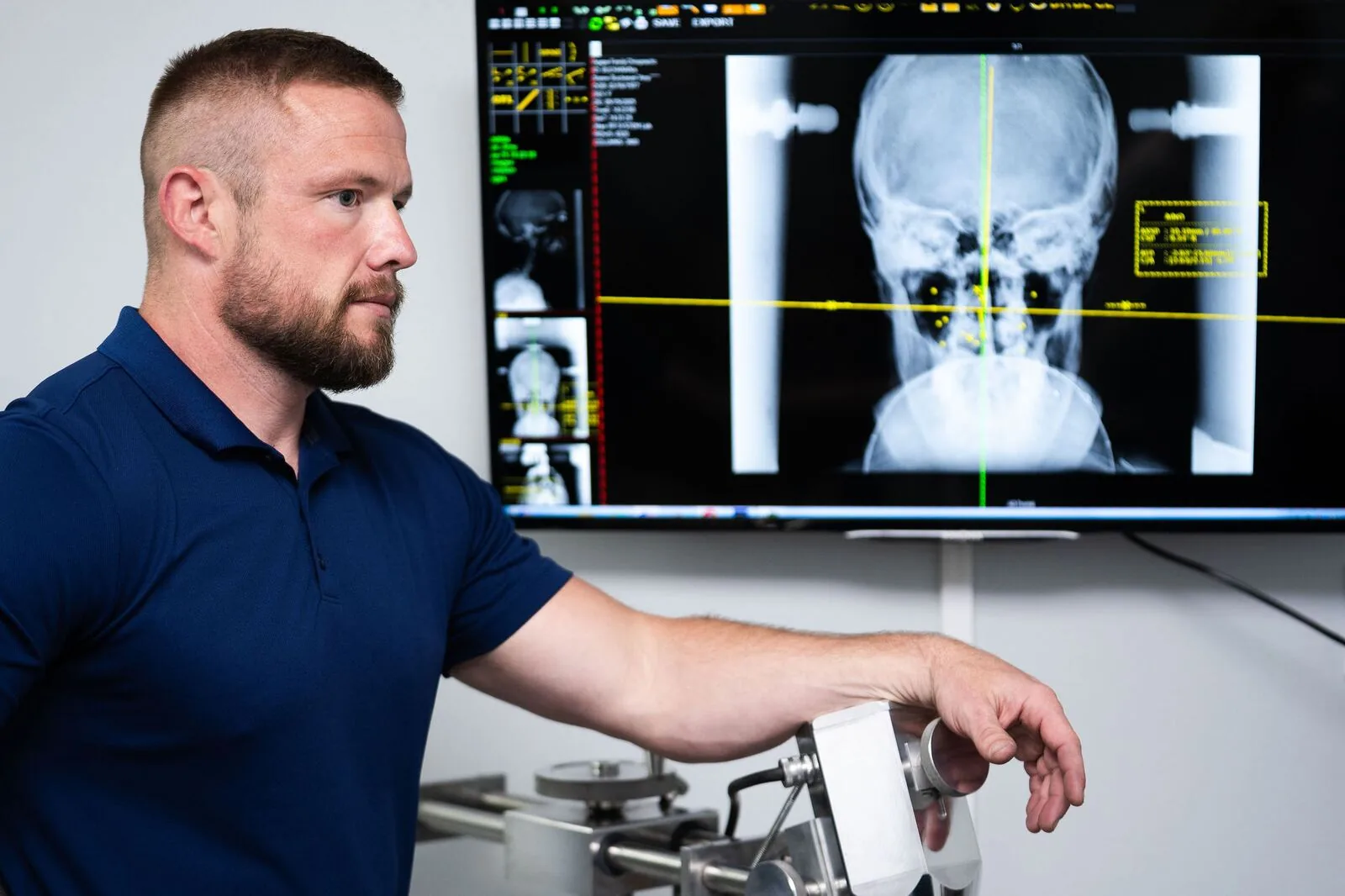
In our own experience, this pattern is a familiar one. Patients who come to us with concussion symptoms that have persisted well beyond the typical two-to-four-week recovery window often show a measurable upper cervical misalignment on imaging, and many describe real improvement in headache frequency and mental clarity within the first several weeks of corrective care. That is this practice's own clinical observation, not a controlled research finding, and individual timelines and results vary — but it is consistent with the pattern reported in the case series above, and it is a large part of why we think a cervical evaluation belongs in the workup for concussion symptoms that haven't resolved.
What should you do if concussion symptoms haven't resolved?
If a concussion's symptoms are still present weeks or months after the injury, the first step is ruling out other causes with a physician or neurologist — persistent symptoms can occasionally reflect something more serious, and that possibility should be evaluated first. Once that's been done, given how often the cervical spine is injured by the same forces that cause a concussion, and how rarely it's assessed as part of standard concussion care, a clinical evaluation that specifically includes the upper cervical spine is a reasonable next step to raise with your care team. This summary does not constitute medical advice and is not a substitute for an individualized clinical evaluation of your specific symptoms.
Key Takeaways
- About 15% of people with a mild traumatic brain injury develop post-concussion syndrome, defined as symptoms persisting beyond three months, according to the NIH's StatPearls clinical reference.
- A 2021 systematic review of 23 studies found neck-related (cervicogenic) symptoms present in up to 90% of people with persistent post-concussion symptoms, and neck pain at initial evaluation increased the risk of developing persistent symptoms by roughly 2.5 to 6 times.
- The same forces that cause a concussion frequently injure the cervical spine at the same time, but standard concussion evaluations rarely include a dedicated neck assessment.
- A small case series of six patients receiving upper cervical-specific chiropractic care for post-concussion syndrome found improvement across multiple validated outcome measures over 12 weeks, though the study had no control group and cannot rule out natural recovery.
- In this practice's experience, concussion symptoms that persist beyond the typical two-to-four-week recovery window often improve with upper cervical care, though individual timelines and results vary.
Have a question about your own situation? We're glad to talk it through.
Request an AppointmentFrequently Asked Questions
Can a concussion cause neck problems?
Yes. The same acceleration-deceleration force that injures the brain during a concussion often stretches or injures the joints, muscles, and ligaments of the cervical spine at the same time, since the neck absorbs much of that force.
Why didn't my doctor check my neck after my concussion?
Standard concussion evaluations focus on neurological and cognitive testing and don't typically include a dedicated cervical spine assessment, even though research shows neck-related symptoms are common, especially when symptoms persist beyond the typical recovery window.
How long do post-concussion symptoms normally last?
Most concussion symptoms improve within two to four weeks, but about 15% of people go on to develop post-concussion syndrome, in which symptoms persist beyond three months.
What is upper cervical care, and how might it help post-concussion symptoms?
Upper cervical care is a chiropractic approach focused specifically on correcting misalignment at the top of the neck. In a small published case series, patients receiving this type of care for post-concussion syndrome showed improvement across several validated symptom measures, though larger controlled studies are still needed.
References
- Centers for Disease Control and Prevention. Symptoms of Mild TBI and Concussion. Traumatic Brain Injury & Concussion.
- Permenter CM, Fernández-de Thomas RJ, Sherman AL. Postconcussive Syndrome. StatPearls [Internet]. Treasure Island (FL): StatPearls Publishing; 2023.
- Cheever K, McDevitt J, Phillips J, Kawata K. The Role of Cervical Symptoms in Post-concussion Management: A Systematic Review. Sports Med. 2021;51(9):1875-1891. doi:10.1007/s40279-021-01469-y
- Morin M, Langevin P, Fait P. Cervical Spine Involvement in Mild Traumatic Brain Injury: A Review. J Sports Med (Hindawi Publ Corp). 2016;2016:1590161. doi:10.1155/2016/1590161
- Moore J. Chiropractic Management of the Craniocervical Junction in Post-Concussion Syndrome: A Case Series. J Contemp Chiropr. 2019;2(1):92-102.
About the Author
Dr. Max Orris is an upper cervical chiropractor at Gateway Upper Cervical Institute in Pacific, Missouri, where he has practiced since 2016. He is certified in the Advanced Orthogonal technique and works with patients whose post-concussion symptoms haven't resolved with standard care.
Related: see the full condition page.
Have questions about your own situation?
Call (636) 271-2960 or request an appointment — we're glad to talk through what you're experiencing.