
Headaches & Migraines
Why Standard Headache and Migraine Care Sometimes Misses the Neck
By Dr. Max Orris, D.C. ·
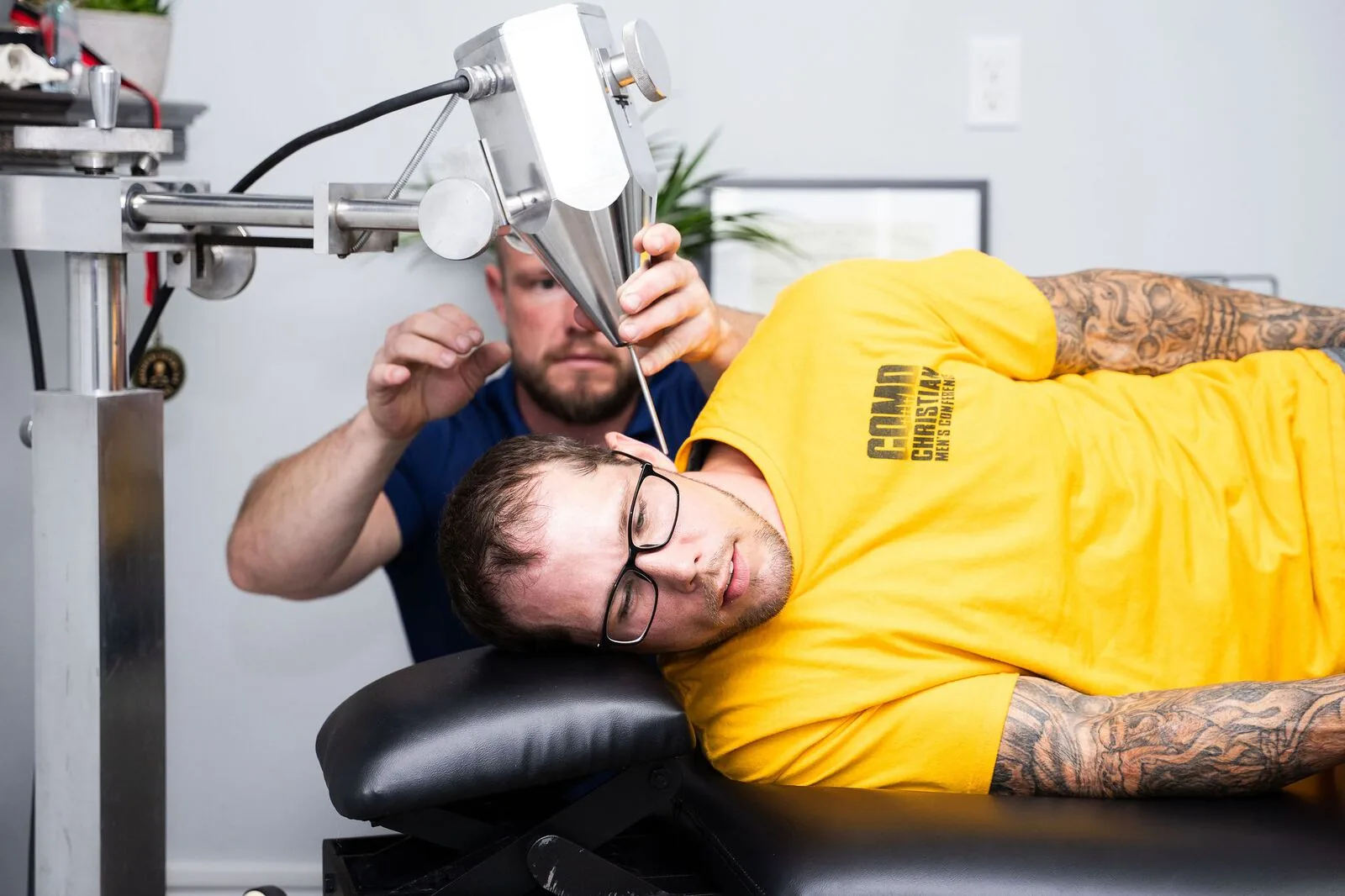
Two published studies have looked specifically at upper cervical correction and headache or migraine outcomes. A large multicenter cohort of over 1,000 patients found clinically meaningful headache pain reductions within about two weeks of care, and a small pilot study of 11 migraine patients found significant improvements in migraine-specific quality of life — though that same pilot study’s primary physiological measurement did not reach statistical significance. Both are real, published findings, and both come with real limitations that are worth understanding before drawing conclusions.
What did the largest study actually measure?
A 2011 study published in BMC Musculoskeletal Disorders followed 1,090 consecutive new patients across 83 upper cervical chiropractic practices — one of the largest real-world studies of this type of care. Researchers tracked neck pain, headache pain, mid-back pain, low back pain, and patient satisfaction using standardized scales, comparing scores at the start of care to scores after about two weeks and roughly 4.5 office visits on average.
Headache pain, measured on an 11-point scale, improved by a statistically significant margin (p < 0.001), and patients reported high satisfaction with care, averaging 9.1 out of 10. The study also tracked mild, short-lived reactions to care (reported by 31% of patients, almost all resolving within 24 hours) and found no reports of serious adverse events across an estimated 5 million career upper cervical adjustments performed by the study’s 83 participating chiropractors.
What did the migraine-specific pilot study find?
A separate 2015 study published in BioMed Research International, registered with ClinicalTrials.gov, followed 11 neurologist-diagnosed migraine patients through 8 weeks of upper cervical correction. This study is smaller and more rigorous in one specific way: it used MRI imaging at baseline, week 4, and week 8 to measure a physiological marker called intracranial compliance, alongside standard migraine disability and quality-of-life questionnaires.
The honest result: the study’s primary outcome — the MRI-measured change in intracranial compliance — did not reach statistical significance across the group of 11 patients, even though about half showed an individual increase. What did reach statistical significance were the secondary, patient-reported outcomes: migraine-specific quality of life scores improved significantly by week four and continued through week eight, headache days per month dropped from a baseline average of 14.5 to 8.7 by the second month, and headache-related disability scores (HIT-6) improved significantly as well.
Why does an unclear imaging result still matter?
It would be easy to only report the encouraging quality-of-life numbers and leave out the unclear imaging finding — but that would misrepresent what the researchers actually found. The study’s own authors were direct about this: with only 11 subjects and no placebo comparison group, they could not determine whether the reported improvements came from the atlas correction itself, from the attention and structure of participating in a study, or from a placebo-type effect. They explicitly called for a larger, controlled trial to sort this out.
That kind of transparency is exactly what makes a pilot study useful — it identifies a promising signal (significant quality-of-life improvement) worth testing properly, without overstating what a small, uncontrolled study can prove on its own.
Which headache types have the clearest anatomical rationale?
Separate from these two clinical studies, there is a well-established anatomical case for a subset of headaches called cervicogenic headache — a headache type the International Headache Society classification places in a separate diagnostic category from migraine, defined by its origin in the cervical spine rather than migraine’s neurological mechanisms. Cervicogenic headache is estimated to account for a meaningful share of chronic headache cases, and its diagnostic criteria specifically include pain that is provoked by neck movement or pressure on the upper cervical joints, along with restricted neck range of motion.
This is a distinct question from whether upper cervical correction helps migraine broadly. A headache that is one-sided, worsens with neck movement, and comes with neck stiffness has a more direct anatomical reason to potentially respond to upper cervical care than a headache with none of those features.
What should this mean if you are considering upper cervical care for headaches or migraines?
Taken together, the evidence is genuinely encouraging but genuinely early: a large real-world cohort with a strong safety record and meaningful headache improvement, and a small pilot study with significant quality-of-life gains but an inconclusive primary physiological measurement. Neither is a substitute for a large randomized controlled trial, and no one should be told otherwise.
What this evidence does support is that a proper evaluation is a reasonable next step for chronic headaches or migraines that have not responded to standard care — particularly if there is a cervicogenic pattern (neck-movement-provoked, one-sided, with neck stiffness). An evaluation that includes imaging of the upper cervical spine can determine whether that pattern is present in your specific case, rather than assuming it either way.
Key Takeaways
- A 2011 multicenter cohort of 1,090 patients found statistically significant headache pain improvement within about two weeks of upper cervical care, with high patient satisfaction and no reported serious adverse events.
- A 2015 pilot study of 11 migraine patients found statistically significant improvement in migraine-specific quality of life and headache days, but its primary MRI-based measurement did not reach statistical significance across the group.
- Neither study included a placebo or control group, so neither can prove that upper cervical correction — rather than another factor — caused the improvement; the pilot study’s own authors called for a larger controlled trial.
- Cervicogenic headache, which is provoked by neck movement and comes with neck stiffness, has the clearest anatomical rationale for a cervical contribution among headache types.
- A proper evaluation, including upper cervical imaging, is a reasonable way to find out whether your specific headache or migraine pattern has a cervical component — rather than assuming the research applies universally.
Frequently Asked Questions
Is there strong scientific proof that upper cervical chiropractic cures migraines?
No, and it would be inaccurate to say otherwise. The published research includes one large real-world cohort study and one small pilot study, both with encouraging results, but neither is a large randomized controlled trial, and the pilot study’s own primary measurement did not reach statistical significance.
What is the difference between a migraine and a cervicogenic headache?
Migraine is a distinct neurological disorder, often with light and sound sensitivity, nausea, and sometimes aura. Cervicogenic headache is classified as originating from the cervical spine itself, typically one-sided, provoked by neck movement or pressure on the upper neck joints, and accompanied by restricted neck motion.
Did the migraine pilot study have any results that were not positive?
Yes. Its primary outcome measure — an MRI-based measurement called intracranial compliance — did not show a statistically significant change across the 11 subjects, even though the same subjects did show statistically significant improvement on separate, patient-reported quality-of-life measures.
How would I know if my headaches have an upper cervical component?
A structured evaluation — health history, neurological screening, and imaging of the alignment at the top of the neck — is what actually answers this. A one-sided headache that worsens with neck movement and comes with neck stiffness is a reasonable pattern to have evaluated specifically.
References
- Eriksen K, Rochester RP, Hurwitz EL. Symptomatic reactions, clinical outcomes and patient satisfaction associated with upper cervical chiropractic care: a prospective, multicenter, cohort study. BMC Musculoskeletal Disorders. 2011;12:219. doi:10.1186/1471-2474-12-219
- Woodfield HC III, Hasick DG, Becker WJ, Rose MS, Scott JN. Effect of atlas vertebrae realignment in subjects with migraine: an observational pilot study. BioMed Research International. 2015;2015:630472. doi:10.1155/2015/630472
About the Author
Dr. Max Orris is an upper cervical chiropractor at Gateway Upper Cervical Institute in Pacific, Missouri, where he has practiced since 2016. He is certified in the Advanced Orthogonal technique and works with patients whose headaches and migraines have not resolved with standard care.
Related: see the full condition page.
Have questions about your own situation?
Call (636) 271-2960 or request an appointment — we're glad to talk through what you're experiencing.